The Process
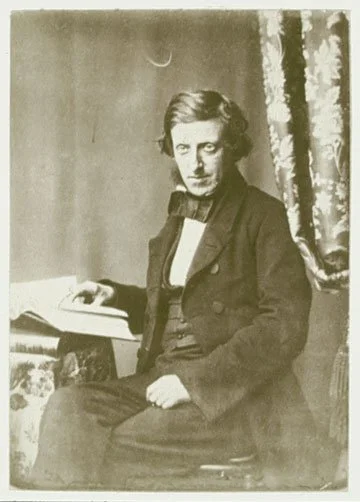
Frederick Scott Archer
by Robert Cade, c. 1855
The wet plate collodion process is one of the very early photographic process dating back to 1851. Invented by Frederick Scott Archer, he gave the gift of photography to the world by publishing the discovery without first patenting it
Collodion is nitrocellulose dissolved in sulphuric and nitric acid then diluted with ethyl alcohol and ether. It is toxic and very flammable. The collodion (salted with iodides and bromides) is poured onto a metal or glass plate to form the base of the emulsion and dipped in a bath of silver nitrate for ~3 minutes. During this time silver iodide is formed on the plate making it sensitive to light. And not just any light. It is sensitive to a narrow spectrum of light on the blue side.
In the red light of the darkroom, the plate is removed from the bath and secured in a light tight plate holder that will go into the back of my large format camera and the exposure is then made. Collodion is quite slow when it comes to its sensitivity to light. As such, the exposures are typically long. 4-8 seconds in the open shade and 1 second in full sun. In my studio I use high power flashes to make exposures that are pretty much instantaneous. Flash power is measured in watt seconds. A standard speedlight flash used with modern cameras produce between 60 and 100 watt seconds at full power. In absence of open shade, I use between 4,800 - 12,800 watt seconds of flash power to make a single exposure. I use a head brace to assist the sitter in remaining within the narrow plane of focus.
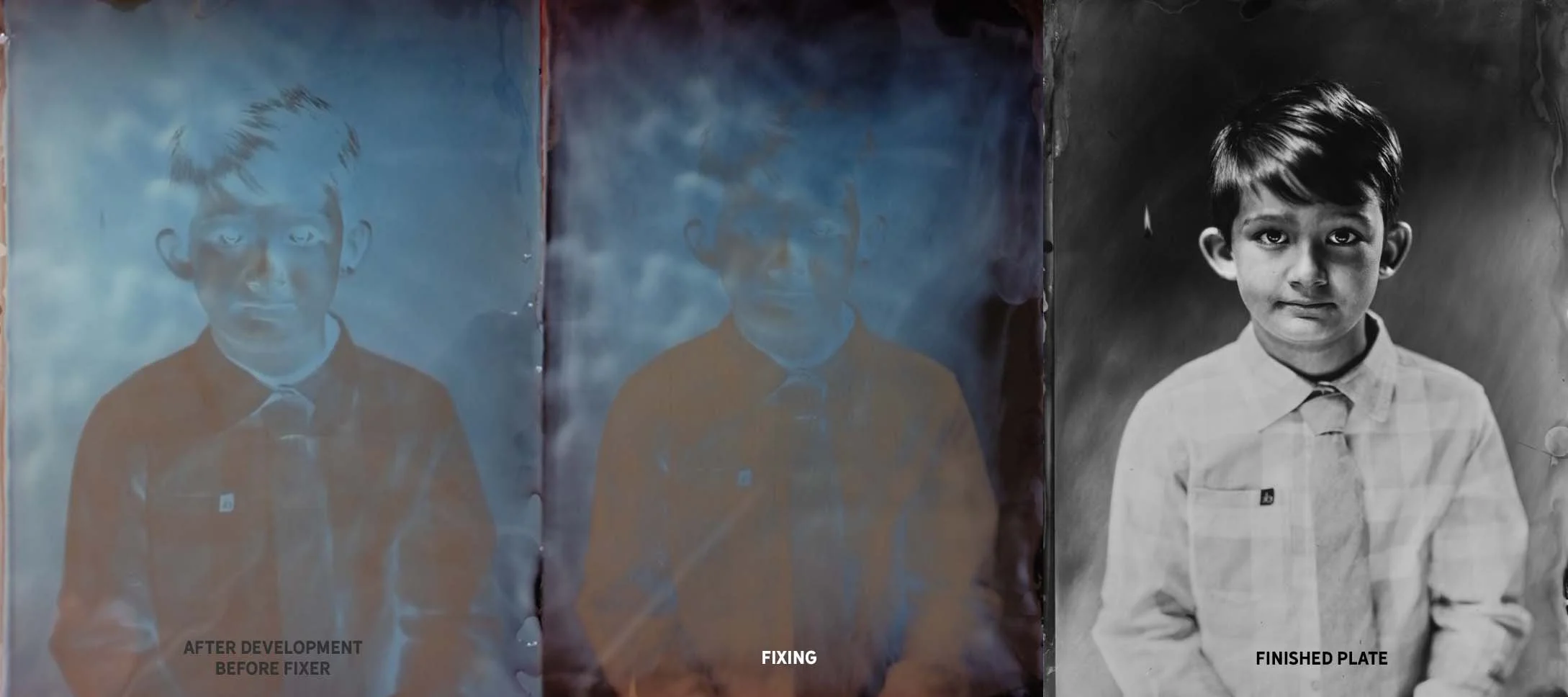
Once the exposure is made the plate has to be developed before it can dry. Hence, the “wet” in wet plate collodion. In either a darkroom or darkbox I pour developer onto the plate, watch and wait for an image to appear. The developer contains ferrous sulphate which reduces the exposed silver halides (silver iodide & silver bromide) into metallic silver. When I feel the plate is sufficiently developed I stop the process with water.
Now the plate is no longer sensitive to light and can be brought out of the darkroom. It looks like a white, cloudy negative at this point. The plate is then submerged into the fixer bath which is where the magic of the process is on full display. The unexposed silver is chemically removed and what is revealed is the final image.